
· by Michael Blair, Nashville's Lawn Care
When a Middle Tennessee lawn grows tan rings in the middle of summer, the grass is usually tall fescue and the weather has usually been hot, sticky and still. The usual culprit is brown patch, a disease UT Extension’s W1359 guide to large patch and brown patch counts among the most common turfgrass diseases in the state. It is worth treating, but a fungicide alone rarely fixes a lawn that keeps getting it. The water schedule, the summer feeding and the mowing height usually decide whether the patches come back next July. Our grub, disease and pest control service starts from that order: confirm what it is, change what feeds it, and spray only where spraying earns its keep.
Brown patch or just July
Fescue is a cool-season grass, and in a long Nashville heat wave it slows down, thins and turns tan whether or not anything is wrong with it. That browning is fairly even across the sunny parts of the yard, it is worst where the soil dries first, and it answers to deep watering. We cover that side of it in why a Nashville lawn goes brown every July.
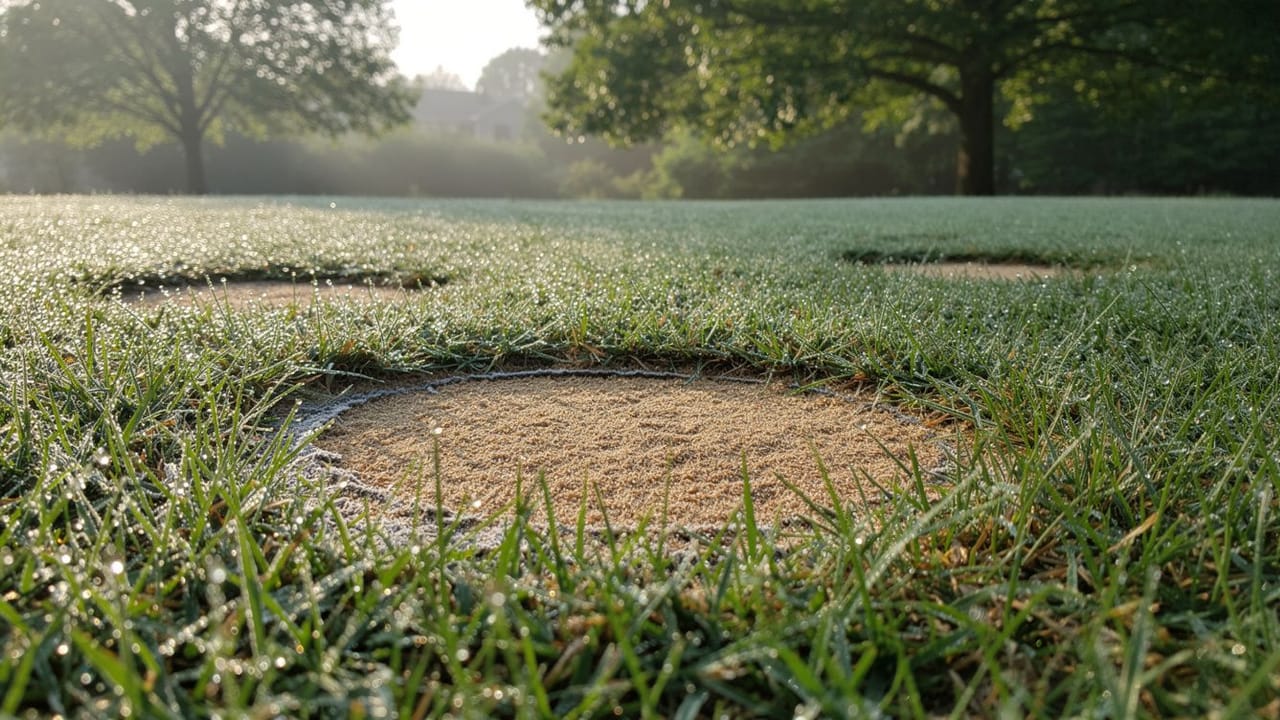
Brown patch looks different once you know what to look for. The UT guide describes irregular, roughly circular patches anywhere from 6 inches to several feet across, sitting inside grass that is otherwise still green. Early in the morning, while the dew is on, the edge of an active patch can show a grayish smoke ring. Pull a few blades from that edge and look closely: brown patch leaves light brown lesions with dark borders on the leaf itself, where heat stress just dries the blade from the tip down. The disease can spread quickly in the right weather, so a patch the size of a dinner plate on Monday can be a few feet wide by the weekend.
The same fungus, Rhizoctonia solani, also causes large patch, but the UT guide explains they come from genetically different strains and hit different grasses at different times. Brown patch is the summer disease of cool-season grass like fescue. Large patch shows up on warm-season grasses such as bermuda and zoysia in fall and spring. A tan ring in a bermuda yard in October is a different conversation from a tan ring in a fescue yard in July.
The weather and the habits that feed it
The conditions the UT guide lists read like a Middle Tennessee forecast: summer soil temperatures above 60 F, with the disease at its worst once overnight lows stay above 70 F and highs reach 90 F, relative humidity above 95 percent, and leaf blades staying wet for at least 10 to 12 hours. Add poor drainage or a corner of the yard with little air movement and the fungus has everything it needs. University of Missouri Extension’s IPM1029 brown patch publication adds that the disease is most severe on tall fescue, which is the grass most Middle Tennessee lawns are planted in.
Nobody can change a humid night, but three habits make it worse and all three can be fixed. The first is evening watering. A sprinkler that runs at 7 p.m. keeps the blades wet straight through the night, which hands the fungus those 10 to 12 hours. The Missouri guide says to water after midnight or in the early morning, and UT says to water deeply but infrequently and not in the evening.
The second is summer nitrogen. Excessive nitrogen is on UT’s list of conditions that favor the disease, and its guide caps feeding at 0.5 pound of nitrogen per 1,000 square feet when conditions favor brown patch. Missouri goes further and says to apply none while the disease is active. The third is cutting fescue short, which leaves less leaf to carry the plant through the heat. Missouri recommends 3 to 3-1/2 inches for tall fescue, and our post on how short to cut grass in Tennessee heat covers the height side in more detail.
Feeding in fall, not in June
The most useful research on this question is a two-year tall fescue trial reported by Kansas State University’s turfgrass program in July 2025. Plots fed 4.5 pounds of nitrogen per 1,000 square feet a year looked very good, but they needed fungicide to stay that way and dropped quickly from July on without it. Plots given 1.5 pounds, all of it in September, held acceptable or just-below-acceptable quality with very little brown patch, even with no fungicide at all.
That trial was in Kansas, and UT has not published an annual nitrogen figure for fescue that we could cite, so take the numbers as the direction rather than a recipe for a Brentwood yard. The direction is the same one the Missouri guide gives: put most of a fescue lawn’s nitrogen down in the fall, and keep the yearly total modest. A fescue program that pushes hard green-up with heavy spring and early summer feedings is, in effect, buying fungicide later. That is the reason our fertilization and weed control program for fescue leans on the fall feedings and goes light once the nights turn warm.
When a fungicide is worth it
A lawn with a few patches after a muggy week often does not need spraying. Missouri Extension notes that fescue frequently recovers from brown patch without fungicide in two to four weeks once the weather breaks, although severe, prolonged conditions can kill the crown of the plant and leave bare ground to reseed in the fall. Mowing can carry on as normal at the higher height, and the Missouri guide says leaving the clippings on the lawn does not make the disease worse.
Fungicide earns its place on lawns that get hit every summer despite good watering and feeding, and on new or high-value turf that cannot afford a thin July. The UT guide says preventive treatment can be effective when it starts in late spring or early summer, once average soil temperatures rise consistently above 68 to 70 F, and repeated on the label’s interval while the weather stays favorable. Waiting until the patches are a foot wide is a curative spray chasing damage that is already done.
Anyone paid to apply a fungicide to your lawn in Tennessee has to be licensed for it. The Tennessee Department of Agriculture’s pesticide certification and licensing page explains that a business doing paid application needs a charter with a licensee in each category it works in. For lawns that is the Horticulture – Lawn and Turf license, which covers turf pests and diseases and requires the Ornamental and Turf Pest Control certification. It is a fair question to ask anyone quoting a fungicide program, and we answer it the same way for our own crews.
If your fescue has rings in it now, or has had them every summer, ask for a free lawn care estimate and tell us when the patches show up, when the sprinklers run and what the lawn has been fed this year. Those three answers tell us most of what we need to know before anyone walks the yard.
Sources
- UT Extension, W1359 Large Patch vs. Brown Patch in Turfgrass: How to Tell the Difference — Symptoms, smoke ring and leaf lesions; favorable temperatures, humidity and leaf wetness; 0.5 lb nitrogen cap; watering advice; preventive fungicide timing at 68 to 70 F soil temperature
- University of Missouri Extension, IPM1029 Brown Patch — Most severe on tall fescue; most nitrogen in fall and none while active; mow 3 to 3-1/2 inches; clippings do not worsen it; water after midnight; recovery in two to four weeks
- Kansas State University Turfgrass, Nitrogen Levels and Use of a Fungicide Clearly Impact Brown Patch on Tall Fescue (July 2025) — Two-year trial: 4.5 lb nitrogen a year needed fungicide; 1.5 lb in September held up with minimal brown patch
- Tennessee Department of Agriculture, Pesticide Certification, Licensing and Charters — Charter and licensee per category for paid application; Horticulture – Lawn and Turf license and Ornamental and Turf Pest Control certification