
· by Michael Blair, Nashville's Lawn Care
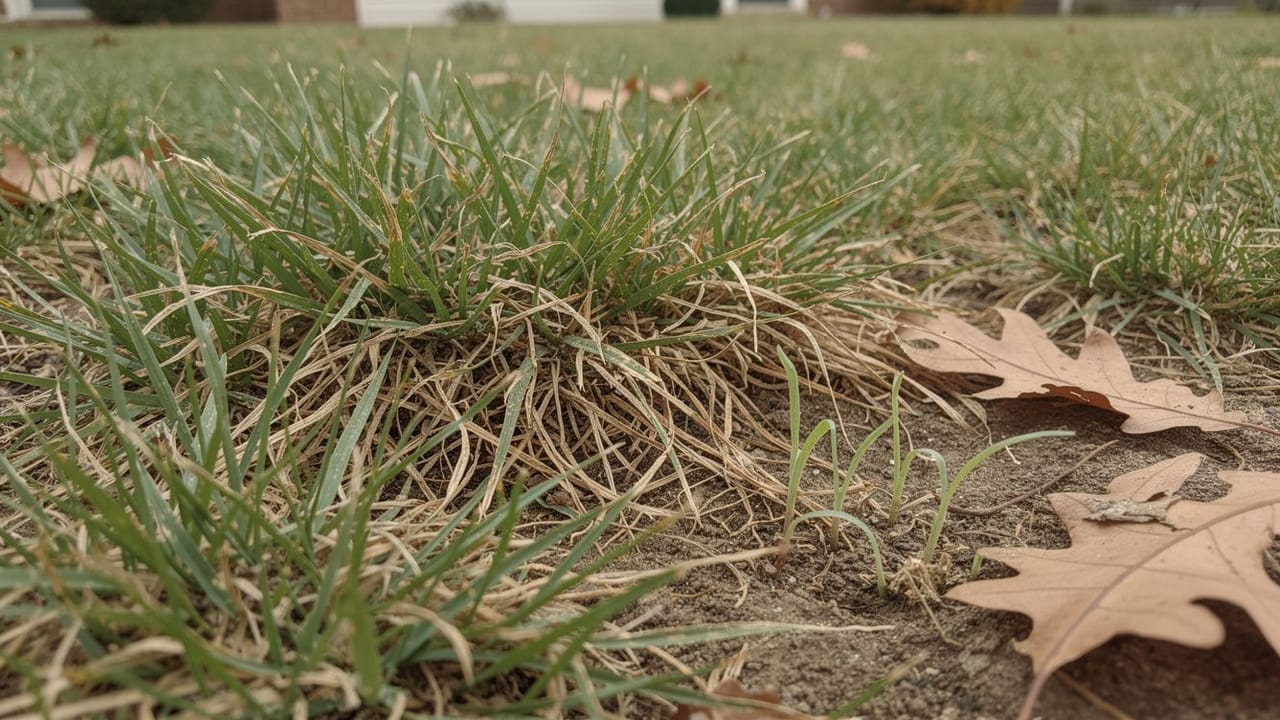
In October a lot of Middle Tennessee fescue lawns show the same thing: wide, flattened clumps of pale brown grass lying across the green, often right along the driveway and the walk where the turf runs thin. Most of the time that is crabgrass finishing its year. It is also the month many of the same lawns are being overseeded, and that is where homeowners get caught, because the product that stops crabgrass does not tell a weed seed from a fescue seed. Our fertilization and weed control program handles the two on separate calendars, and this post explains why.
Why is the crabgrass turning brown in October?
It is turning brown because its year is nearly over. UT Extension’s W 146 guide to crabgrass control in turfgrass describes large and smooth crabgrass as summer annuals that come up mainly in spring, grow through the summer, make their seed in the fall and die after the first killing frost. Smooth crabgrass is the one the guide calls most common in Tennessee turf.
So the clump fading out by the mailbox is not going to green up again next year. What matters is what it left behind. By the time it browns, the plant has already dropped its seed into the thin spots around it, and that seed is what comes up in the spring.
That timing also explains why spraying old crabgrass in the fall is usually poor value. The W 146 guide notes postemergence products work best on young plants with fewer than two tillers, and that bigger plants with three or more need repeat applications. A sprawling October clump is about as big as crabgrass gets, and frost will finish it shortly anyway.
Should crabgrass preventer go down when you overseed?
No, not most of them, and not at the same time. The W 146 guide explains that a preemergence herbicide works by keeping germinating seedlings from developing into mature plants. A fescue seedling is in exactly that stage for its first weeks, so a product spread to stop crabgrass can stop the seed you just paid for.
The Sumner County office of UT Extension, in its fescue lawn maintenance sheet, names fall as the recommended season to establish or overseed fescue, with February and March second best. That is the reason we do the aeration and overseeding work in the fall and leave the crabgrass preventer for spring: the two jobs sit at opposite ends of the year and do not have to fight. The timing side of the seeding is covered in our post on when to overseed a fescue lawn in Nashville.
How long to wait between seed and preventer depends on the product, and the label on the bag is what governs. As an example of how those intervals read, Purdue’s turf program in Indiana lists them in its table of herbicide delays after seeding:
- Prodiamine: 60 days after seeding or until after the second mowing, whichever is longer.
- Dithiopyr: only on well-established turf that has had at least two mowings.
- Siduron: can go down before seeding cool-season grass and any time after it germinates.
- Mesotrione: before seeding, or four weeks or two mowings after emergence, whichever is longer.
When does crabgrass preventer go down around Nashville?
It goes down before the crabgrass seed sprouts, and the guide to that is the ground, not the calendar. According to W 146, crabgrass germinates in spring once soil temperatures stay above 55 F for four days and nights in a row, and forsythia blooming is the sign to watch. The first application should be on before the last forsythia blooms drop.
The UT guide gives target dates for West Tennessee and for East Tennessee, but none for Middle Tennessee, so we do not quote one. We watch the soil and the forsythia. The Sumner County sheet puts the same idea as a rule of thumb: spread the preventer between forsythia bloom and dogwood bloom. That sheet comes from the county extension office that serves Gallatin and Hendersonville.
A preventer also has to be watered in to work. W 146 calls for roughly half an inch of rain or irrigation within 24 to 48 hours of the application. One treatment holds for about 12 to 16 weeks, and a second application six to eight weeks after the first stretches that coverage further into summer.
If the spring window slips past
Missing the forsythia window is common, and it is not the end of the season. W 146 says dithiopyr, sold as Dimension, and Echelon both give some postemergence control on young crabgrass along with the preemergence barrier, and that Tenacity paired with Barricade is another option. Its table lists which of these are safe on tall fescue, because some products in it are meant only for warm-season grasses like bermuda. On every one of them, the guide says the label takes precedence over its own advice.
For a fall-seeded lawn, the order of work stays simple. Seed now at the rate the Sumner County sheet gives for overseeding, 2 to 3 pounds per 1,000 square feet, since it warns that more seed is not better and makes for weaker, more disease-prone plants. Keep the new grass mowed through the fall, which our post on the first mow after overseeding walks through. Then the spring preventer in our fertilization and weed control program goes down once the label’s waiting period after seeding has passed.
If the crabgrass came through your fescue this year, or you are seeding this fall and want the spring treatment lined up behind it, ask for a free lawn care estimate. Tell us when the lawn was last seeded and what has been spread on it this year, and we can set both dates from there.
Sources
- UT Institute of Agriculture, W 146 Crabgrass Species Control in Turfgrass — Crabgrass life cycle and death at first frost; smooth crabgrass most common in Tennessee; how preemergence works; 55 F soil and forsythia timing; half inch of water within 24 to 48 hours; 12 to 16 weeks of control; postemergence options and tiller counts; label takes precedence
- UT Extension Sumner County, Maintaining Your Fescue Lawn — Fall as the recommended overseeding season, February and March second; 2 to 3 lb of seed per 1,000 sq ft for overseeding; more seed is not better; preventer between forsythia and dogwood bloom
- Purdue University Turfgrass Science, Herbicide Delays after Seeding — Example label intervals after seeding for prodiamine, dithiopyr, siduron and mesotrione (Indiana source; the product label governs)
FAQ
Dead Crabgrass and Fall Overseeding in Nashville — questions
Does crabgrass die in the winter?
Yes. UT Extension describes large and smooth crabgrass as summer annuals that die after the first killing frost, so the plant itself does not survive a Middle Tennessee winter. The seed it dropped in the fall does, and that seed sprouts the following spring once the soil warms past 55 F.
Does crabgrass come back every year?
The same plant does not, but a new crop usually does. Each crabgrass plant lives one season and sets seed in the fall before frost kills it. Those seeds sit in the thin spots of the lawn and germinate in spring, which is why a preventer timed before germination matters more than spraying the old clumps.
Does crabgrass preventer stop grass seed from growing?
Most of them can. A preemergence herbicide keeps germinating seedlings from developing, and new fescue is a seedling for its first weeks. Labels set a waiting period after seeding; Purdue lists prodiamine at 60 days or two mowings, whichever is longer. Siduron is one exception that can go down before seeding.
When should I put down crabgrass preventer in Tennessee?
Before crabgrass sprouts, which UT Extension ties to soil above 55 F for four days and nights in a row. Forsythia blooming is the visual cue, and the first application should be down before its last blooms fall. The Sumner County office puts it as anytime between forsythia bloom and dogwood bloom.
Should crabgrass preventer be watered in?
Yes. UT Extension’s crabgrass guide calls for about half an inch of rain or irrigation within 24 to 48 hours after the preventer goes down, which moves it into the soil where it works. A single application holds for about 12 to 16 weeks, and a second one six to eight weeks later extends that.