
· by Michael Blair, Nashville's Lawn Care
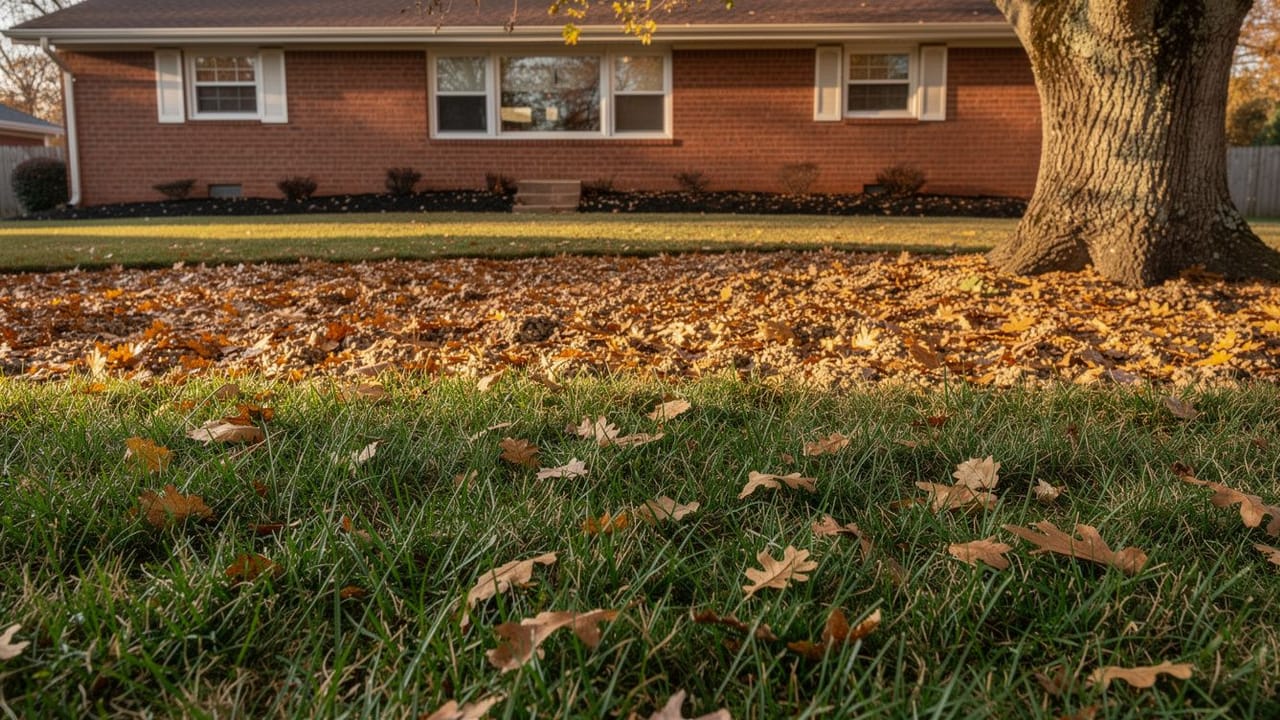
Leaves come down across Middle Tennessee in the fall, and that is one of the two seasons fescue grows best. UT Extension’s publication on thatch puts it plainly: fescues grow best during cool, moist conditions in spring and fall. What you do with those leaves matters more on a fescue lawn than it would on one where the grass had already gone dormant for the winter.
Why the timing is the problem
Tall fescue is the most common cool-season grass in Tennessee home lawns, according to UT Extension’s guide to selecting fescues. The same guide credits it with excellent heat and drought tolerance but says it often needs pesticide applications to control brown patch, and UT’s calendar has fescue lawns treated for that disease every 28 days from May through July. Fall is when the grass gets a break from all of that, and we cover the summer side of it in our post on brown patch in Nashville fescue.
Whatever the lawn is recovering from, it does the work through photosynthesis, and UT’s fact sheet on basic turfgrass requirements says photosynthesis cannot occur without an appropriate amount of light. A leaf layer thick enough to hide the grass keeps that light off it for as long as it lies there. Water is the other casualty. In the materials table of UT’s publication on mulching trees and landscapes, the note on leaves warns that thick layers can obstruct water absorption.
Can you mulch leaves into the lawn instead of raking?
You do not have to rake a light drop at all. UT Extension’s 2025 lawn maintenance calendar lists “mulch leaves while mowing” among the October jobs for tall fescue, and for bermuda and zoysia lawns too. Chopped leaves are organic matter, and UT’s mulching publication says organic mulches decompose into the soil, adding to its organic matter and improving soil structure and nutrient availability. They are not much of a fertilizer, though. UT’s guide to making and using compost lists leaves as a brown with a carbon-to-nitrogen ratio of about 100 to 1, and it warns that high-carbon material worked into soil before it breaks down makes microbes draw on the nitrogen already there. Whether your soil is short of anything is a question for a soil test, which is where we start every fertilization program, and UT’s calendar has October fescue fed according to soil test recommendations.
On our weekly mowing routes in the fall, the mower goes over the leaves on every visit while the layer is still thin, rather than once at the end of the drop, and the deck stays where the calendar’s one-third rule keeps it. Our crews check each pass the same way. If the chopped pieces drop down between the blades, it worked; if they sit on top of the turf, the layer was too thick for one pass and gets another, or the bagger.
When leaves have to come off
There is no extension figure we know of for how deep a leaf layer can get before the mower stops helping. We go by sight. When grass no longer shows through the leaves, a mulching pass only turns them into a carpet of small pieces, and that layer comes off instead.
Wet leaves are the real trouble. A layer that has been rained on and pressed flat is exactly the kind of thick leaf cover UT warns can keep water from soaking in, and in our experience the mower cannot chop it fine enough to settle into the grass. If you have been away and come back to a matted layer, take it off rather than trying to mow through it. When the drop has gotten ahead of you, our fall cleanups take the leaves off the lawn and the beds, and you can tell us about the yard for a free quote.
- Mulch while the layer is thin and dry
- Remove anything matted or rained-flat
- Keep leaves off newly overseeded areas until the first mowing
- Keep leaves out of gutters and off hard surfaces
- Stop mulching once shredded pieces sit on top rather than settling
What should I do with leaves raked off the lawn?
Leaves raked off the lawn do not have to go to the curb. UT’s mulching publication counts leaves among the organic mulches, though its table rates shredded bark as one of the best materials and says to compost leaves first. Once they are composted, a bed mulched 2 to 4 inches deep gets what UT describes as an insulation effect, with soil kept warmer in winter and cooler in summer. The same publication cautions that more than 4 inches restricts the oxygen getting to the roots.
Leaves on their own break down slowly, because a pile that is mostly browns lacks the nitrogen the microbes need. The EPA’s guide to composting at home counts dry leaves as a carbon-rich brown, suggests two to three parts browns to one part greens such as food scraps or grass clippings, and says chopping material into smaller pieces helps it break down faster. Run through the mower first, leaves are already most of the way there. Under ideal conditions UT puts a well-built batch pile at four to eight weeks, while a pile that is added to continuously can take 12 to 18 months. Finished compost can raise a bed’s organic matter over time and increase how much water it holds, by UT’s account. If you use clippings as the green, UT warns that clippings from a lawn treated with a long-residual herbicide stay out of the pile, since some herbicides remain active through composting.
Sources
- UT Extension, PB1903 2025 Lawn Maintenance Calendar — October: mulch leaves while mowing (tall fescue and bermuda/zoysia), one-third rule, fertilize fescue by soil test; brown patch treated every 28 days May through July
- UT Extension, W159-E Turfgrass Selection: Fescues — Tall fescue the most common cool-season home lawn grass in Tennessee; excellent heat and drought tolerance; brown patch control; slower to build thatch than bermuda or zoysia
- UT Extension, W161-M Turfgrass Maintenance: Thatch — Fescues grow best in cool, moist spring and fall; what thatch is; nitrogen and compaction in thatch management; dethatch at half an inch
- UT Extension, W161-A Turfgrass Maintenance: Basic Turfgrass Requirements — Photosynthesis cannot occur without an appropriate amount of light
- UT Extension, SP617 Mulching Your Trees and Landscapes — Organic mulches add organic matter; thick leaf layers obstruct water absorption; shredded bark rated among the best, compost leaves first; insulation; 2 to 4 inches, more restricts oxygen
- UT Extension, W1391 Making and Using Compost in Residential and Community Gardens and Landscapes — Leaves 100:1 carbon to nitrogen; high-carbon material draws soil nitrogen; batch pile four to eight weeks, continuous pile 12 to 18 months; compost raises organic matter and water holding; herbicide-treated clippings out of the pile
- US EPA, Composting At Home — Dry leaves are carbon-rich browns; two to three parts browns to one part greens; smaller pieces break down faster
FAQ
Leaves on the Lawn and What They Do to It — questions
Can I just leave the leaves where they fall?
Mow over them instead of leaving them whole. UT Extension’s lawn calendar recommends mulching leaves while mowing in October, which chops a light drop into the lawn. Under mature trees the layer gets thick enough to keep light and water off fescue in one of its best growing seasons. Our test is whether you can still see grass through the leaves; if you cannot, they need mowing over or removing.
Should I mulch leaves into a lawn I just overseeded?
Not until the new grass has had its first mowing. Until then our crews keep leaves off the seeded areas with a blower on a low setting or a light rake, because the seedlings need all the light they can get. Once the young grass has been cut, a thin layer can be mulched in the same way as on the rest of the lawn.
Do leaves cause thatch?
Thatch, as UT Extension describes it, is the turfgrass’s own roots, stems and leaves building up on the soil surface faster than they decay, so fallen tree leaves are not what UT is describing. The prevention steps UT lists include using nitrogen fertilizer judiciously and relieving soil compaction, and its fescue guide notes that tall fescue does not usually build thatch as quickly as bermuda or zoysia. UT says dethatching is often recommended once thatch reaches half an inch.
How long do leaves take to break down?
In a compost pile, UT Extension puts a well-built batch at four to eight weeks under ideal conditions, while a pile that keeps getting added to can take 12 to 18 months. Leaves alone break down slowly because they lack nitrogen, so mix two to three parts leaves with one part greens and chop them first.