
· by Michael Blair, Nashville's Lawn Care
November in Middle Tennessee brings the first mornings when the whole yard turns white, and with them the same questions: is it all right to walk across it to the car, can the mowing crew still come, did the frost just ruin the lawn? Frost on its own is part of every fall here. What hurts the grass is weight on it while it is frozen. Here is what happens to a blade under a foot or a wheel, why frost shows up on nights that never officially froze, and how we schedule lawn mowing around it.
Is it bad to walk on frosted grass?
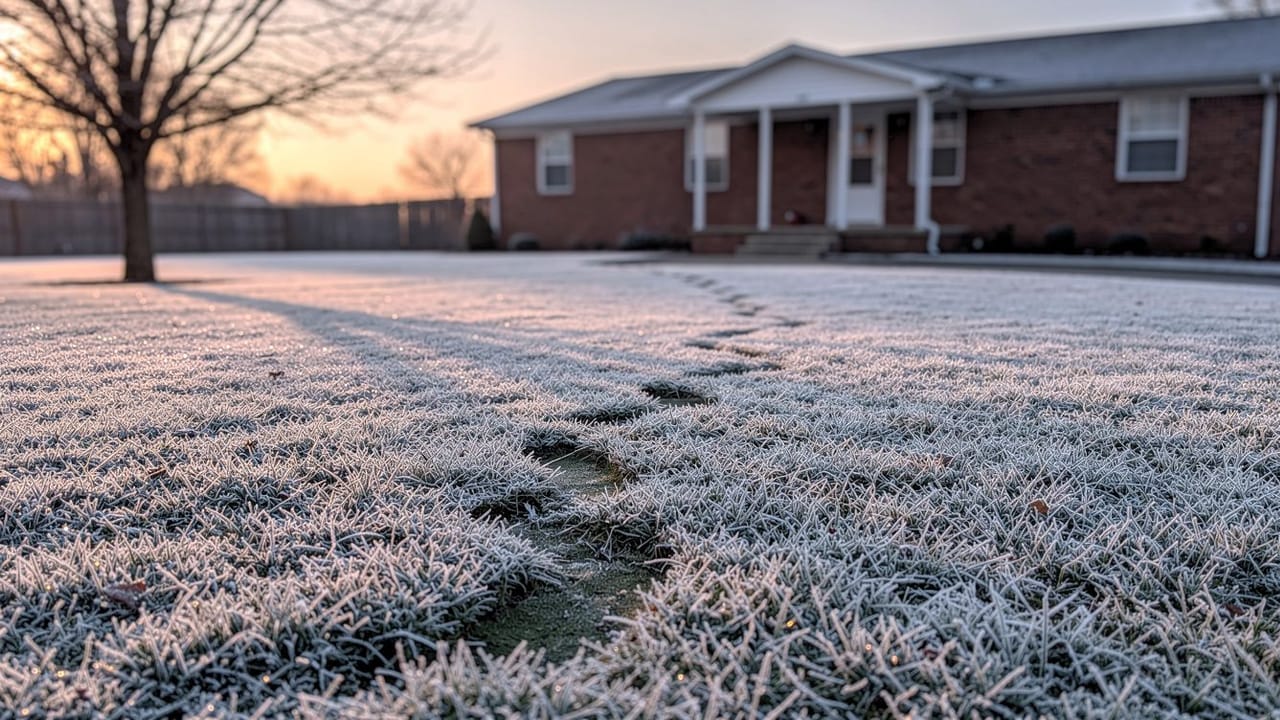
Walking on frosted grass injures it, because a frozen blade cannot bend under weight the way a thawed one does. In a 1977 Virginia Tech extension article on frosted and frozen turf, turf specialist John Shoulders wrote that any traffic on turf while frost is present causes injury: the blades in each footprint die, while the crown and roots usually come through with little or no damage. A vehicle across frosted grass does the same along its tracks.
Kansas State turf researcher Jared Hoyle gives the mechanism in a K-State turf newsletter note on early frost: the ice crystals on the leaves cut into the plant’s cells when someone steps, drives or mows on them. His point about timing fits a Nashville November too. Damage done late in fall has little growing time left to heal before winter.
Why is there frost when the low was above freezing?
Frost forms on nights the forecast low stayed above 32 because the grass sits in colder air than the thermometer measures. The National Weather Service office in La Crosse explains that on clear, calm nights a thin layer of air at the surface can run up to 10 degrees colder than the air 4 to 5 feet up, where readings are usually taken. Its example is an air temperature of 36 with 30 degrees or colder at the ground.
The same page notes cold air is heavier and settles in valleys, which also shelter it from wind. That is why the low corner of a yard, the strip along a creek and the lawns in a hollow are white while the slope above is not, and why the first frost tends to arrive on different mornings in different parts of the same neighborhood.
When can the mower go back on a frosted lawn?
The mower can go back on once the frost has melted completely and the blades have had time to dry. A mower is heavier than a footprint and its wheels cover every inch of the lawn, so a frosty-morning cut leaves the whole yard striped with damaged grass. On frosted mornings our crews wait for the frost to burn off, then mow; wet grass after the thaw brings its own problems, covered in our post on mowing wet grass.
What happens next depends on the grass. UT Extension’s 2024 Lawn Calendar keeps tall fescue on its one-third mowing rule through the fall, while for bermuda and zoysia its November entry is to stop mowing after frost, since those lawns are headed into dormancy. Our post on the last mow of the year covers the height to finish at.
Frozen ground and the thaw
Traffic does the most harm while the ground is freezing or thawing, not once it is frozen solid. Shoulders wrote that cells are especially vulnerable while turf and soil are in the process of freezing, and that the riskiest stretch comes when the surface has thawed but the soil just beneath it is still frozen. Roots tear easily then, and the frozen layer underneath keeps water from draining, so the top stays soft and wet.
A practical test from the same article: if walking on the grass leaves footprints, it needs more time to thaw. Keep the shortcut across the yard to the mailbox off the lawn on those mornings, and park trailers and trucks on the driveway. If a path of brown footprints has already appeared, tell us where it is and we will look at whether it needs anything beyond time.
Sources
- Virginia Tech Extension, Preventing Injury to Frosted or Frozen Turf (John F. Shoulders, Tech Turf Topics, 1977) — Any traffic on frosted turf causes injury; blades in footprints die, crowns and roots usually spared; worst damage during freezing and thawing; footprints mean more thawing needed
- Kansas State University, Turf and Landscape Newsletter: FROST… Already? (Jared Hoyle, 2015) — Ice crystals cut leaf cells under pressure from walking, driving or mowing; little time to recover before winter
- National Weather Service La Crosse, Frost conditions — Surface air up to 10 degrees colder than at 4 to 5 feet on clear, calm nights; 36 F air with 30 F at the surface; cold air settles in valleys
- UT Extension, 2024 Lawn Calendar — Fescue mowed by the one-third rule in fall; bermuda and zoysia: cease mowing after frost; raise height half an inch for dormancy; lingering footprints as a drought sign
FAQ
Walking or Mowing on Frosted Grass in Nashville — questions
Is it OK to mow grass after a frost?
Not until the frost has fully melted and the blades are dry. Frozen blades break under the weight of the mower and its wheels, and every pass leaves a stripe of dead leaf tips. Once it thaws, fescue can be mowed as usual, while UT Extension says to stop mowing bermuda and zoysia after frost.
Can frost form above 32 degrees?
Yes. The National Weather Service explains that on clear, calm nights the air touching the ground can be up to 10 degrees colder than the air 4 to 5 feet up where temperatures are measured. A reading of 36 can mean 30 degrees or colder on the grass, which is enough for frost.
Why are there brown footprints in my lawn?
In late fall the usual cause is someone walking across the grass while it was frosted, which kills the blades pressed down in each print. In a dry spell, UT Extension treats footprints that linger in the lawn as a sign of drought stress, meaning the grass is too short of water to spring back.
Should you mow bermuda grass after a frost?
Generally no. UT Extension’s lawn calendar lists stopping mowing after frost as a November task for bermuda and zoysia, which are going dormant and have stopped growing. Raising the mowing height by at least half an inch earlier in the fall is the step that prepares them for winter.
Does frost hurt the roots of grass?
Traffic on a frosted lawn mostly kills the leaf blades; Virginia Tech’s turf specialist found the crown and roots usually escape. Roots are at greater risk during a thaw, when the surface has softened over still-frozen soil and anything walking or driving on it can tear them.