
· by Michael Blair, Nashville's Lawn Care
A week of rain in Middle Tennessee leaves a lawn with two problems at once: the grass keeps growing, and the yard never quite dries. Cutting it anyway is tempting, especially in a spring flush. The mower’s own manual and the turf specialists at three universities give reasons to wait that go well beyond a messy deck. Here is what each of them says, what it means for a fescue lawn here, and how our weekly lawn mowing crews decide whether a yard is ready to cut.
Is it bad to mow wet grass?
Mowing wet grass is bad for the person behind the mower first and the lawn second. Toro’s walk-behind manuals, including the Super Recycler 21-inch operator’s manual (2008), tell owners never to run the mower in wet grass, and the warnings explain why: wet grass is slick, and a slip on it can mean contact with the blade. The same manual names wet grass and steep slopes together as the places where footing gives out.
The lawn has reasons of its own. Wayne Wells, writing in Mississippi State University Extension’s Turf Tips newsletter on soggy lawns (2009), advised leaving a water-soaked lawn uncut until it dries, to avoid compacting the soil, spreading disease and piling up clippings. Compaction is the one our aeration service exists to undo, so there is little sense in adding to it on a wet morning.
Why does wet grass clog a mower?
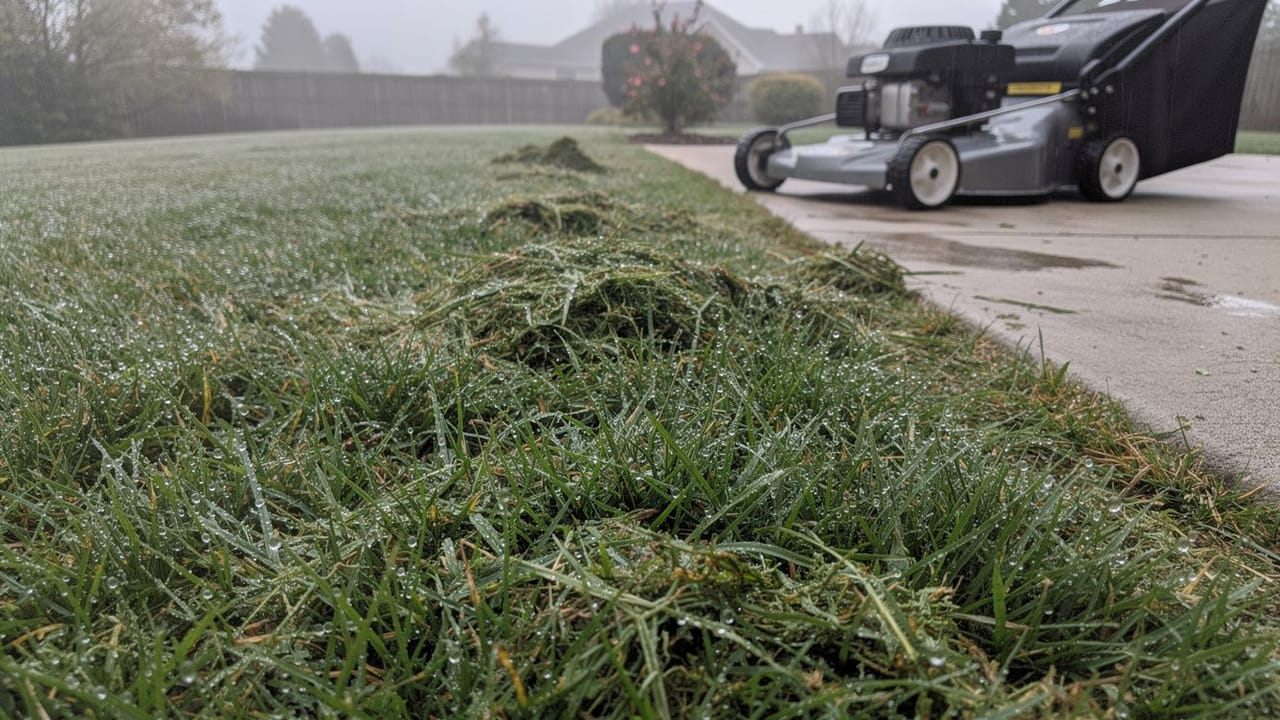
Wet grass clogs a mower because damp clippings stick together instead of scattering. Toro’s manual says so in its maintenance pages: wet grass and wet leaves tend to clump in the yard, and they can plug the mower or stall the engine partway through a cut. A deck that keeps packing up means stopping again and again, and the clumps it drops do not go anywhere useful.
Those clumps are the heavy clipping piles Mississippi State warned about. On a dry day, short clippings sift down between the blades and disappear; wet ones lie on top in mats. Our post on whether to leave or bag grass clippings covers the normal week. A wet week is the exception, when the clumps are worth raking up or catching in a bag rather than leaving them where they fell.
Does mowing wet grass spread lawn disease?
Mowing wet grass can help spread lawn disease, according to the turf program at the University of Massachusetts Amherst. Its disease management guidance points out that mowing wounds grass and can carry disease-causing organisms from place to place. It recommends cutting dry turf whenever possible, keeping blades sharp so they cut rather than tear, and washing mowers and changing the order of lawns when some of them have active disease.
The University of Kentucky’s Disease Management in the Home Lawn fact sheet (2014) makes the blade point too: a dull mower shreds grass, and the torn tips can let fungi in. None of these sources blames wet mowing for one disease in particular. Still, tall fescue here has a summer problem in brown patch, and a lawn showing it is the one we least want to cut wet and then drive to the next yard.
How do you know the lawn is dry enough to cut?
A lawn is dry enough to cut when the blades are dry to the touch and the ground stays firm underfoot. None of the sources we used gives a set number of hours after rain, and the honest answer moves with sun, wind and how much fell. Mississippi State’s test is whether the lawn is still water-soaked; Toro’s is whether you can keep your footing. A morning of heavy dew counts as wet grass on both, and it is the test our crews use before a mower comes off the trailer.
Waiting has a cost as well. The Kentucky fact sheet, written with tall fescue in mind, says not to let grass get taller than 4 to 5 inches between mowings, and a long wet spell can push a lawn past that. When it does, we bring the height down over more than one cut instead of taking it all at once, as explained in how short to cut grass. If your lawn has fallen behind after a rainy stretch, send us the address and we will get it back on schedule.
Sources
- The Toro Company, 21in Super Recycler Lawn Mower Operator’s Manual, Form No. 3361-146 Rev A (2008) — Never operate the mower in wet grass; wet grass and slopes cause slips and blade contact; wet grass and leaves clump and can plug the mower or stall the engine
- Mississippi State University Extension, Turf Tips: Soggy lawns and fall turf diseases (Wayne Wells, 2009) — Do not mow a water-soaked lawn until it dries, to prevent compaction, disease spread and heavy clipping accumulation
- UMass Amherst Extension Turf Program, BMPs for Lawn, Landscape and Turf: Disease Management — Mowing wounds turf and can spread pathogens; mow dry turf when possible; keep blades sharp; wash mowers and change mowing order when lawns have active disease
- University of Kentucky Cooperative Extension, Disease Management in the Home Lawn, PPFS-OR-T-11 (2014) — A dull blade shreds grass and can open wounds for fungi; do not let grass exceed 4 to 5 inches between mowings
FAQ
Is It Bad to Mow Wet Grass? The Mower and the Lawn — questions
Can you mow when the grass is wet?
You can, but the people who build mowers and the people who study turf both say not to. Toro’s walk-behind manuals warn against mowing wet grass because of the risk of slipping into the blade, and the UMass Amherst turf program advises mowing dry turf whenever possible, because mowing can spread disease.
Will mowing wet grass hurt the lawn mower?
It can stop one. Toro’s manual says wet grass and leaves tend to clump and can plug the mower or stall the engine, and the clumps then sit on the lawn. Keeping the blade sharp matters either way, since Kentucky and UMass extension specialists both note that a dull blade shreds grass instead of cutting it.
How long after rain should you wait to mow?
No source we use gives a fixed number of hours, because drying depends on sun, wind and how much rain fell. Wait until the blades are dry and the soil is firm underfoot. Mississippi State Extension advises waiting out a water-soaked lawn to avoid compaction, disease spread and heavy clippings left on the grass.
What happens if you mow wet grass?
Several things at once, according to the sources we cite. Footing is poor, which Toro ties to blade injuries. Clippings clump and can stall the mower. The soil compacts, and mowing wounds can carry disease across the lawn, according to Mississippi State and UMass Amherst extension. Each one is avoided by waiting for dry grass.