
· by Michael Blair, Nashville's Lawn Care
Drive through Oak Hill or any older Nashville neighborhood in spring and you will see two kinds of mulched trees: a wide, flat ring with the base of the trunk showing, and a tall cone of mulch packed against the bark. The second one looks tidy and does the tree real harm. Mulch is one of the cheapest things you can do for a tree, but the depth and the width matter more than the brand or the color. This is what University of Tennessee Extension recommends, how we apply it on our yard cleanup and mulch service, and the mistake that builds up a little more every year.
How deep should mulch be around a tree?
Two to four inches, and no deeper. UT Extension’s publication SP 617, Mulching Your Trees and Landscapes, by Wayne K. Clatterbuck, says a layer in that range holds down weed germination and growth, and that going past 4 inches restricts the exchange of oxygen between the soil and the roots. Roots that are short of air in the soil may grow up into the mulch itself, where they dry out in a hot spell.
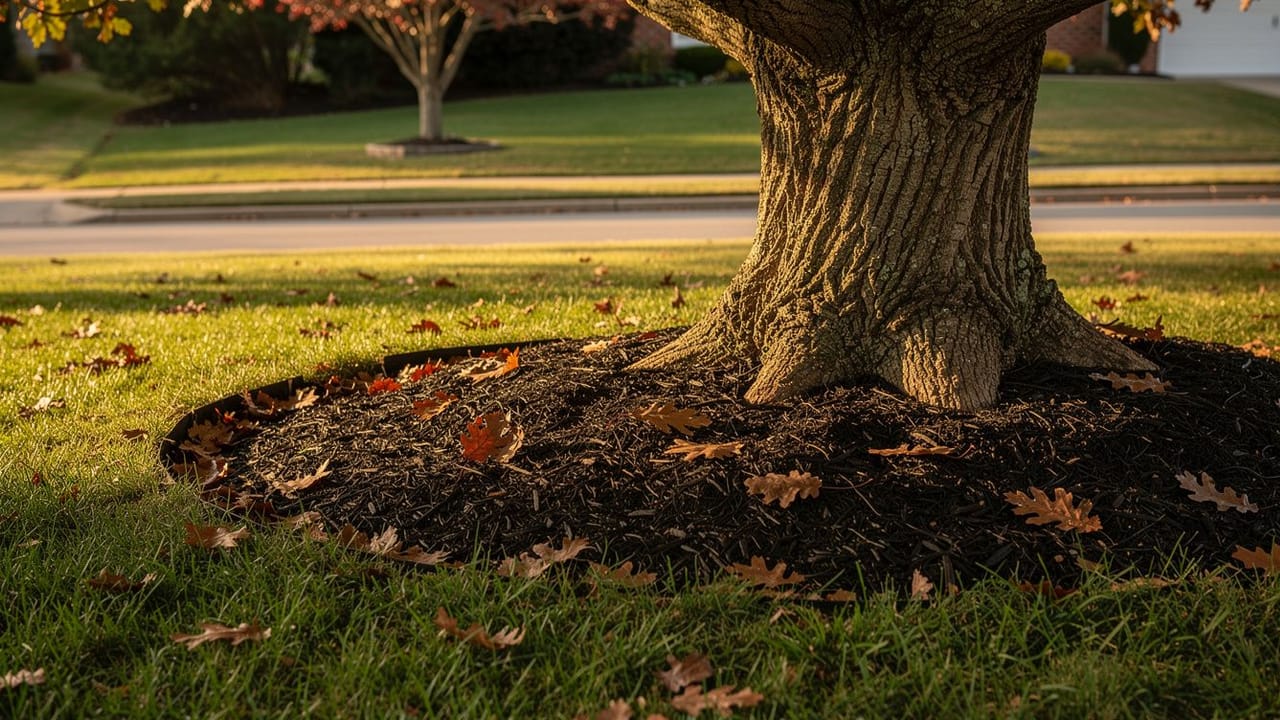
The ring should taper to nothing at its outer edge, so it meets the grass at ground level instead of ending in a ledge. A flat, even layer also sheds less into the lawn when it rains and is easier to mow along.
What is wrong with a mulch volcano?
It holds moisture against the bark, which is exactly where a tree does not want it. SP 617 describes the volcano as a cone 8 to 12 inches high and about 2 feet across, and says the damp conditions it creates at the base of the trunk encourage bark cracking, insects and fungi, and give rodents cover to chew around the trunk and girdle it. Bark is built to stay dry; the roots are the part that wants the mulch.
The fix is to rake the pile back. SP 617 says not to pile mulch against the trunk and to pull it several inches away, and UT Extension Knox County’s June 2022 Tree News adds that the whole trunk flare, where the trunk widens into the roots, should be visible. If you cannot see the flare on your tree, it is buried.
How wide should the mulch ring be?
At least 4 to 6 feet across, and wider is better. SP 617 points out that roots usually reach well past the drip line, the edge of the canopy, and that a bigger mulched area means less competition between the tree and the lawn for water and nutrients. The Tree News newsletter goes further and says the ideal ring reaches the drip line.
That competition is also why grass struggles near a tree. If you are fighting thin turf under a canopy, our post on why grass will not grow under your trees covers the shade and water side of it; often the better answer is a wider ring and less lawn.
Why does a yearly top-up end up too deep?
Because shredded hardwood does not disappear in a year, so fresh mulch lands on top of last year’s. SP 617 says organic mulches have to be replenished as they decompose, which is the point: add only what has broken down. Two inches spread every spring over a layer that has only lost one turns a correct ring into a 4-inch one in a couple of seasons, and the extra tends to pile up against the trunk first.
So we check the depth before we add any. Push a finger or a trowel down to soil in a few spots; if the old layer is already 2 inches or more, it needs a light refresh for color at most. The Tree News advice for a ring that has gotten too deep is to spread it wider rather than thicker, which also gives the roots more room. One more caution from SP 617: fresh sawdust or raw wood waste lacks nitrogen and can draw it from the soil as it breaks down, and fresh grass clippings heat up as they decay, so neither belongs in a ring around a tree.
Across Nashville lawn care accounts we refresh hardwood beds once a year, usually in spring, and fall cleanups are when we pull back whatever has crept against trunks. If your trees are sitting in volcanoes now, ask us for a free estimate and we will reset the rings to the right depth.
Sources
- University of Tennessee Extension, SP 617: Mulching Your Trees and Landscapes (Wayne K. Clatterbuck) — The 2 to 4 inch depth, oxygen restriction past 4 inches, the volcano and its harm, a ring at least 4 to 6 feet across, roots beyond the drip line, replenishing as mulch decomposes, fresh sawdust and grass clippings
- UT Extension Knox County, Tree News, June 2022 — Mulch 2 to 4 inches deep, ideally to the drip line, widen rather than deepen, keep the trunk flare visible
FAQ
How Deep and How Wide to Mulch Around a Tree — questions
Should mulch touch the trunk of a tree?
No. UT Extension’s SP 617 says not to pile mulch against the trunk and to pull it several inches away. Mulch held against the bark keeps it damp, which encourages cracking, insects and fungi and gives rodents cover to chew the trunk. The flared base of the tree should stay visible.
Is mulch good for trees?
Yes, in the right amount. A 2- to 4-inch layer holds down weeds, and a wide ring cuts the competition between the tree’s roots and the lawn for water and nutrients. Too much mulch does the opposite: past 4 inches it restricts oxygen to the roots, and a cone against the trunk invites decay.
When is the best time to mulch around trees in Nashville?
We refresh hardwood mulch once a year, usually in spring after the beds are cleaned out. Check the depth first, because last year’s layer is often still there. Fall cleanup is a good time to rake back any mulch that has drifted against trunks, so the root flare stays visible through winter.
Can you use fresh wood chips or sawdust as tree mulch?
Fresh sawdust and raw wood waste are a poor choice. UT Extension’s SP 617 notes they lack nitrogen and can pull it from the soil as they break down. Fresh grass clippings heat up as they decay. Shredded hardwood that has had time to age is the safer choice around a tree.